


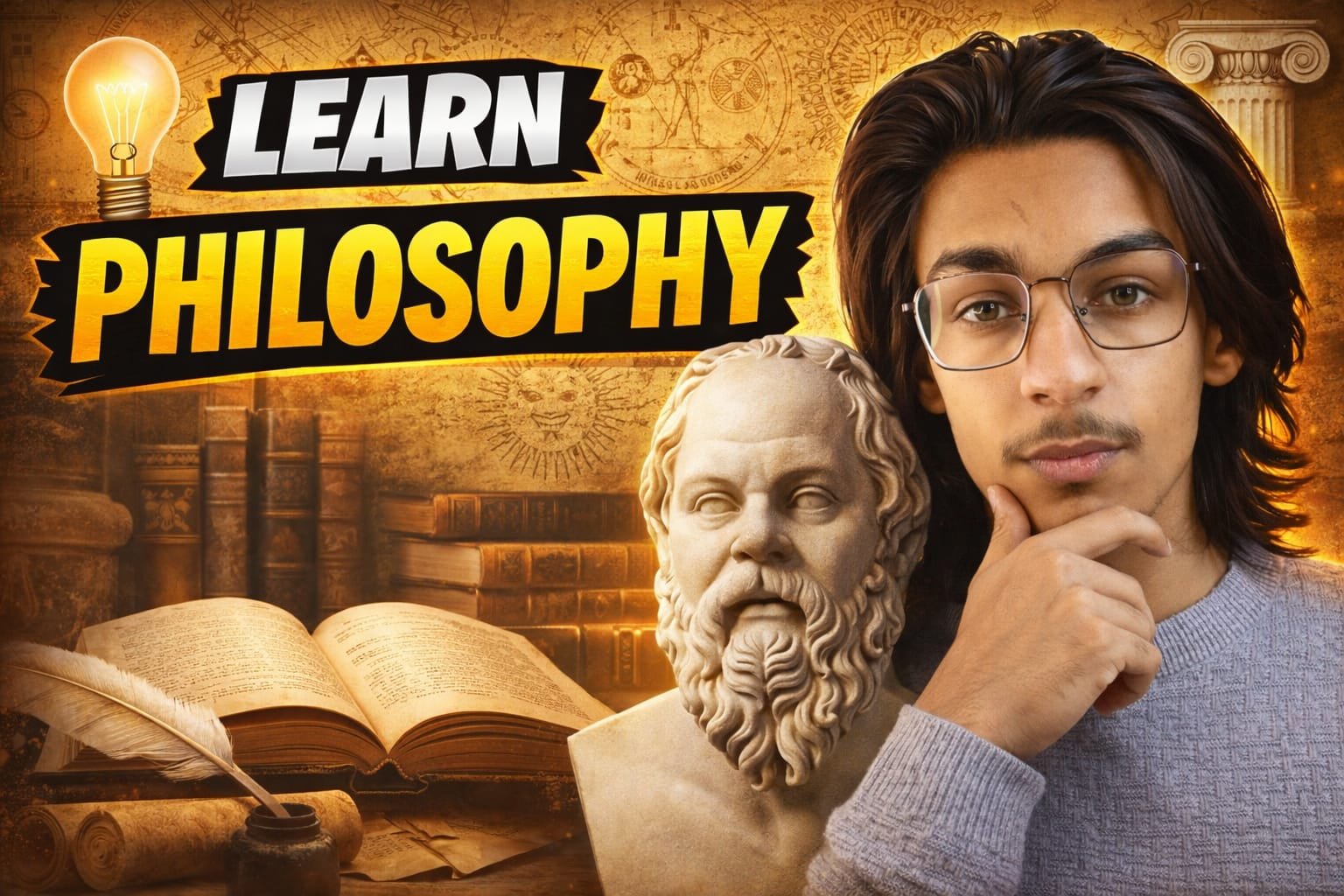


People react with surprise when I tell them my academic background includes an MA in Philosophy. The response is usually some version of "what does that have to do with web development?" The short answer: everything. The longer answer is this post.
Philosophy taught me how to think — not what to think, but how. And thinking clearly, systematically, and with epistemic humility turns out to be one of the most important skills in software development. Let me walk you through the specific connections I've discovered.
"The unexamined life is not worth living."
Logic: The Language of Both Disciplines
Formal logic — propositional logic, predicate logic, argument structure — is foundational in philosophy. You learn to identify premises, conclusions, valid inference patterns, and logical fallacies. You learn the difference between an argument that is valid (the structure is correct) and one that is sound (valid AND the premises are true).
Programming is applied logic. Every conditional is a logical proposition. Every function is an argument: given these premises (inputs), this conclusion (output) follows. Every bug is, at its root, a logical error — a place where what the code says doesn't match what was intended.
Philosophy trained me to decompose arguments carefully, to distinguish what I know from what I'm assuming, and to trace the steps of an inference chain. I use exactly those skills every time I debug a complex issue or design a system architecture.
A developer who can think clearly about the problem will always outperform one who can only write clever code about the wrong problem.
Argument Structure and Requirements Analysis

One of the most valuable skills philosophy teaches is argument analysis: given a claim, what assumptions does it rest on? What would need to be true for this to be correct? What would falsify it?
In software development, this maps directly to requirements analysis. When a client says "we need users to be able to share their content," a philosophically trained mind automatically asks: what counts as content? Who can they share with? Under what conditions? What does sharing actually mean — read access, copy, repost? What happens when a shared item is deleted?
These aren't pedantic questions. They're the questions that prevent you from building the wrong thing. Most software projects don't fail because of bad code — they fail because the wrong problem was solved, or because assumptions were never surfaced and questioned. Philosophy taught me to surface those assumptions before writing a line of code.
Epistemic Humility: The Developer's Greatest Virtue
Perhaps the most practical thing philosophy teaches is epistemic humility — knowing the limits of your knowledge and being calibrated in your confidence. Over-confident developers make terrible architectural decisions. They choose solutions they're familiar with when the problem demands something different. They assume they understand the user when they've never talked to one.
Epistemology — the study of knowledge and justification — trains you to constantly ask: how do I know this? What's my evidence? What am I assuming? How confident should I be? These habits make you better at estimation, better at design, and better at recognizing when you're wrong early enough to course-correct.
What this looks like practically
- Saying "I think this will take 2-3 days, but I'd want to investigate the API first" instead of giving a false-precise estimate
- Writing tests that capture your assumptions, making them checkable rather than invisible
- Seeking feedback on designs before building them
- Being willing to change your technical opinion when given good evidence
If You Haven't Studied Philosophy, Start Here
You don't need an MA. Read a basic logic textbook and work through the exercises. Read anything by Bertrand Russell on clear thinking. Study the classic logical fallacies — you'll start spotting them in technical discussions constantly. Read some philosophy of mind if you're interested in AI and consciousness.
More than any specific framework or language, learning to think clearly is the skill that compounds. A developer who can think well can learn any stack. A developer who thinks poorly will have the same problems no matter how many languages they add to their resume.
Philosophy won't teach you to write better PHP. But it will teach you to solve better problems — and that, in the end, is what the job is actually about.